Building organisations for a realitythat refuses to stand still.
Operator, author and business builder working on how organisations recognise changing reality, exercise better judgement and adapt before circumstances remove the choice.
More than two decades inside the problem.
The work did not begin with a management theory. It grew from leading, changing and building organisations across very different environments, and repeatedly encountering the same question: what happens when reality changes faster than the organisation?
Leading where performance has consequences.
More than 20 years leading multi-site teams and complex operations across retail, manufacturing, distribution, supply chain and eCommerce. The work has included executive and board roles in organisations such as Greencore, Connect Group, Wilko and Premier Foods.
Working where yesterday's operating model is no longer enough.
Leading and advising through turnaround, restructuring, strategic change, operating-model redesign and organisational transformation. Much of that work has happened while the organisation still had to perform today, even as the assumptions underneath tomorrow were moving.
Experiencing changing reality from the other side of the table.
Founding businesses, building new propositions and investing in ventures has provided a different perspective: what it feels like when a plan is yours, the logic once made sense, and external conditions move anyway.
Organisations rarely fail to adapt because nobody is intelligent enough to see what is happening. The harder problem is whether the institution allows what people can see to challenge what it already believes, change the judgement and become coordinated action.
The plan can still make sense. Reality can move anyway.
Some of the most important lessons behind this work came not from organisations that were badly run, but from situations where intelligent people had a reasonable plan and the conditions supporting it changed.
Until its environment changed.
I co-founded and ran an outsourced HR and leadership development business successfully for around five years. Then Covid-19 changed the market around it. What had worked before was no longer enough to make the same model work afterwards.
Until the goalposts moved.
I have invested in ventures where the original plan was coherent, the opportunity appeared real and capable people were involved. External conditions moved anyway. A sound thesis at one point in time did not guarantee continued relevance.
That still struggled to move.
Across large organisations, boards and transformation environments, I kept encountering another pattern: people could often see the problem. The harder issue was whether challenge survived hierarchy, whether assumptions could be reopened and whether better judgement could become action.
I became less interested in asking why organisations fail to execute their plans and more interested in a different question: what makes an organisation capable of recognising when the plan itself needs to change?
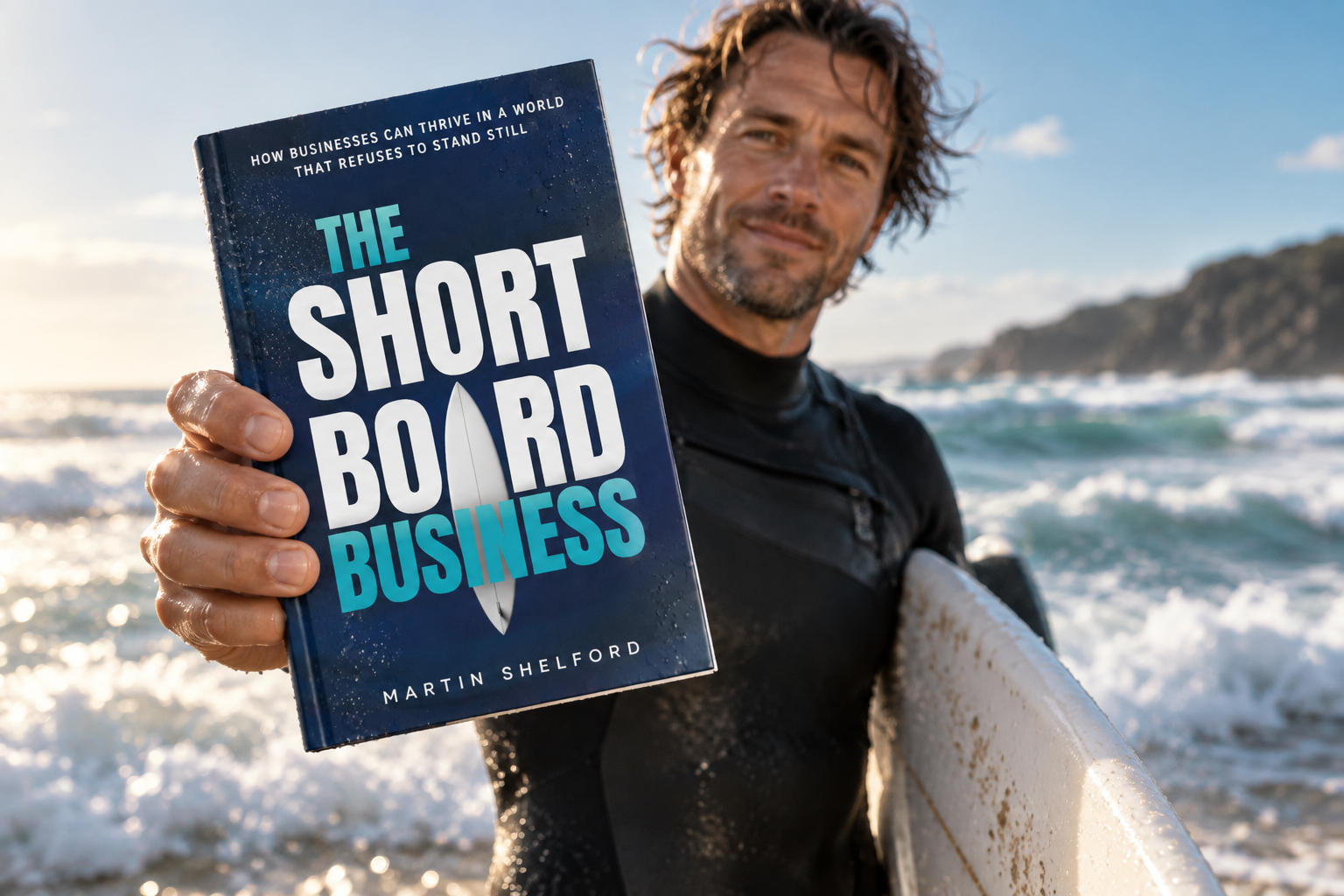
That question led first to The Shortboard Business and its model for organisational adaptability. It then opened a deeper field: Institutional Judgement Capability - the conditions that determine whether what people can see becomes coherent judgement and coordinated action.
A good plan can become a bad plan without anybody doing anything wrong.
The work today is focused on that gap - helping organisations see changing reality, judge it more coherently and move while meaningful choice remains.
One question.A growing body of work.
The book, the research and the products are not separate ideas. They are different ways of working on the same underlying problem: how do organisations remain capable of seeing, judging and moving as reality changes?
The Shortboard Business
A model for organisational adaptability built around three cumulative waves: Lean Dependability, New Growth and Perpetual Relevance. The objective is to allow today, tomorrow and the future to exist side by side rather than forcing the organisation to choose between them.
Explore The Shortboard BusinessInstitutional Judgement Capability
The organisational capability to recognise changing conditions, challenge assumptions, exercise coherent judgement and turn that judgement into coordinated action. IJC asks what determines whether intelligence inside an organisation becomes intelligent institutional behaviour.
Explore Institutional JudgementFrom ideas to application: understand, change and support.
Signal Intelligence
An AI-powered organisational diagnostic designed to surface what the organisation knows through adaptive conversations rather than static surveys. It reveals signals, assumptions, contradictions and friction that leadership may not otherwise be able to see or connect.
Explore Signal IntelligenceLeading Through Reality
Executive diagnostic and leadership development work for senior teams navigating material change. It helps leaders understand what has changed, challenge the assumptions beneath the current approach and build the capability to keep adapting.
Explore Leading Through RealityShortboard Advisor
An AI judgement companion being developed for leaders making consequential decisions. It is designed to challenge framing, surface assumptions, preserve the reasoning around a decision and revisit that judgement as evidence changes.
Explore Shortboard AdvisorThe Shortboard Business provides the model. Institutional Judgement Capability goes deeper into the conditions under which organisations interpret and act on reality. Signal Intelligence helps them understand. Leading Through Reality helps them change. Shortboard Advisor helps keep better judgement close to the decisions that follow.
The ideas are meant to be challenged.
Writing is part of how the work develops. The aim is not to produce management commentary for its own sake, but to test ideas against evidence, experience and other bodies of thought. The argument should become stronger through contact with disagreement.
When Intelligent People Create Unintelligent Institutions
Published by the Global Peter Drucker Forum, this essay explores why intelligence inside an organisation does not automatically become intelligent institutional behaviour, and places Institutional Judgement Capability in continuity with Drucker's argument for deliberately creating disagreement before important decisions.
Explore the Drucker ForumThe Shortboard Business
The organisational model that began the current body of work. The book explores how organisations can perform today, create new growth and build for future relevance at the same time through three cumulative waves.
Explore the bookThe themes running through the work.
What are we assuming?
The most dangerous assumptions are often the ones that once worked well enough to stop feeling like assumptions.
Can disagreement survive hierarchy?
Institutions need more than intelligent people. They need conditions in which evidence and dissent can change what authority believes.
Can judgement become movement?
Seeing reality clearly is not enough if structure, incentives or governance prevent the organisation from acting on what it discovers.
Case studies, articles and Notes from the Water.
The wider library follows these ideas through real organisations, current questions and the evolving work on institutional judgement.
Start with what has changed.
The most useful conversations rarely begin with a solution. They begin with something in the organisation that no longer behaves as expected.
If your leadership team is dealing with material change, a strategy that feels less dependable, signals you cannot quite reconcile or a consequential decision that deserves more challenge, tell me what is happening.
The question is rarely whether reality will change. It is whether the organisation can change with it.